


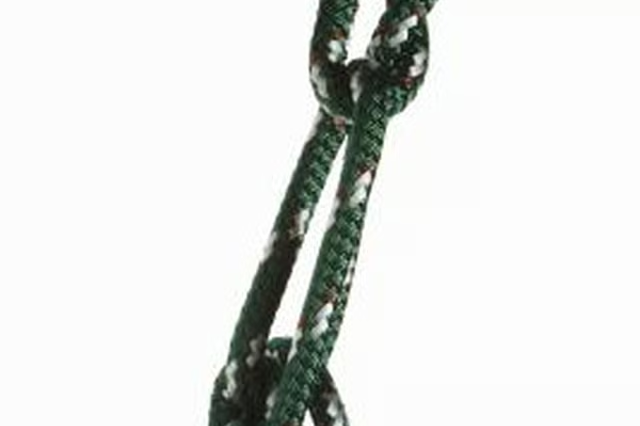
A ratchet allows you to tighten a rope by pulling on one end. When you stop pulling, the mechanical system prevents the rope from sliding backward. The big advantage is that a ratcheting system helps you easily tighten a rope. Although mechanical ratchets work nicely, several knots do the same thing with less equipment.
Taut-line Hitch
When you want a taut rope between two objects, such as a clothing line strung between two trees or a tent's guy line running between the tent and a tent stake, consider using the taut-line hitch. You tie one end of the rope around one of the objects; this becomes the fixed end. Then, you pass the loose end behind the other. You tie the taut-line hitch using the loose end back around the rope. When you push the knot toward the fixed end, it acts like a pulley system and tightens the line. When you let go of the knot, it binds in place.
Trucker's Hitch
The trucker's hitch works as a ratchet to hold down items often in the back of a truck, but paddlers also use it to tie canoes and kayaks on the top of cars. You fix one end of the rope to one side of the truck and pass the rope over the load. To create the knot, tie a slipknot in the rope, pass the loose end of the rope through a tie-down point and back through the slipknot. Pulling on the loose end tightens the rope. Secure it with a half hitch.
Munter Hitch
The munter hitch works as a belay knot. Climbers used it before the invention of mechanical belay devices, but it also gives a ratcheting effect. For this knot, you fix the rope on one end and pass it to a fixed carabiner on the other. To tie it, twist the rope to form a loop. Place the loop in the carabiner. Take the rope on the far side of the loop and pass it back through the carabiner, following the same path as the near side of the original loop.
Guarde Knot
The guarde knot works only in one direction, and you can't reverse it while it's under load. Climbers use it to haul loads or during rescues. When you release the loose end, it locks. To tie it, fix one end of the rope to the load and pass the other through two carabiners. Take the loose end and pass it through the opposite carabiner so the end comes down between the two carabiners. Pull the loose end to haul up the load.